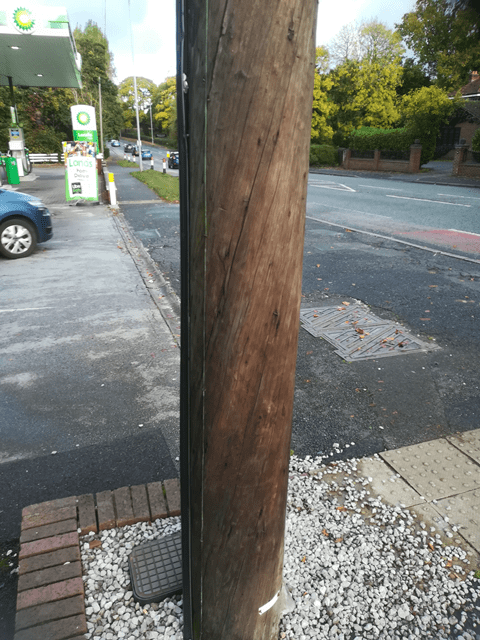
Having lost his phone recently to an opportunist thief my friend lived for a week back in the 1970s. Liberation and frustration were the extremes he expressed that week but overall he said it was a good week. One day he was waiting to meet up with a colleague and without the distraction of a phone to play with he spent some time looking at a telegraph pole. He noticed the timber of the pole was twisting slowly as it rose.This drew his attention, and later on mine as he described what he saw.
Amazingly some trees grow with a spiral grain and when cut for long poles the twist can continue. Seemingly as they season in position, possibly at the corner of your street, they can twist up to 15o. This spiralling phenomenon is to do with the complex structure that allows sap to rise and water to travel during growth. it’s beautiful yet we cut trees down and with forced processes dry them, soak them in tar and stand them on a street corner all looking the same.
A tree spiraling as it grows is not misbehaving; it’s expressing individual creative freedom, its own unique growth path. Like the growth rings and position of each branch these are the fingerprints that say look at my uniqueness! From the roadside a forest of pine or conifer might all look the same but they are not. The closer we look the more we see them individually.
Take a teacher for instance, their challenge is not to dump information but to bring each individual child to a place of new understanding. What a job! 30 kids staring at you and you have to see each one individually, know their names, notice the nuances of their learning needs whilst making space for them to be who they naturally are. Teachers tell me that this process which puts 30 different life paths in one room at the same time is hard. To manage this we create a set of core skills which are valuable but maybe don’t serve everyone’s individuality.
Nothing wrong with core skills in education except we don’t know how to stop once we start. I use the words life pathway rather than career path but so called core skills are really all about what kind of career or work you will do.
Governments tell us the nation is gearing up for a certain industry and we need a workforce with specific skills. In the early 2000s we were telling kids to learn computing, today we are telling them about plumbing and engineering. Somehow the individual gets lost and what was once an expression of uniqueness, setting us apart is shaped out of us, we become telegraph poles! The child singer who can’t stop singing and wants to be a singer should see singing and music as their core skills. Dad says you need a proper job mum says stop dreaming and get in the real world.
Sadly we can do this in the faith context too. We have a set of core teaching which we might focus our faith on rather than relationship with God. To overplay our description of what it means to, let’s say pray as a Christian can make us all sound and say the same prayers. God for good reason created us as unique and individual. We have a part to play in the unfolding drama of faith that no other human being can play. I wonder how we can be together as a church and retain our freedom to grow as only we can.
Although my friend’s week without the mobile was unplanned it made him stop and look. That telegraph pole is one which he and I have looked at a thousand or more times. But that day he looked deeper and saw the uniqueness and creative growth pattern that not even the saw mill, pressure drying or tar coating could force out.
So I guess if our children are to have a fighting chance at retaining their unique and individual life path we need to see them as individuals in class. If in our faith experience we need to leave room for each one to walk with God as God leads them.
I can’t walk past a telegraph pole now without looking for its individuality, I want that for the teacher looking at their classroom of pupils and the person of faith stood in the congregation.

 Rob Wykes
Excellent.
LikeLike