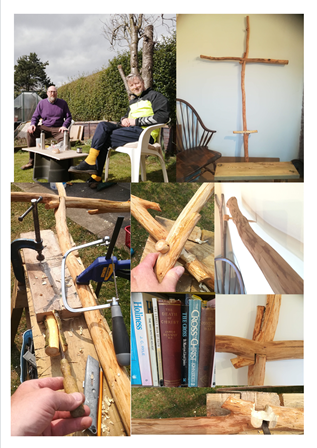
We had an old tree in the garden offering no shade to my friend Ben and I as we sat chatting. It was leaning into the property behind us and slowly dying. So I took it down with a bow saw, dug up the root and have used a section to make a 2 meter high cross. Why a cross? And why so big?
The cross reminds us of daily sacrifice. In the gospel of Mark chapter 8 Jesus predicts His death and in so doing offers up a challenge: “Whoever wants to be my disciple must deny themselves and take up their cross and follow me. For whoever wants to save their life will lose it, but whoever loses their life for me and for the gospel will save it. What good is it for someone to gain the whole world, yet forfeit their soul?”
I have never worn a cross nor do I come from a tradition that regularly makes the sign of the cross. Such activity is not offensive to me. In recent times my exploration of saints noted for their aesthetic life, plus a couple of delightful rest giving visits to Glasshampton monastery has piqued my interest.
Placing my newly made cross in the study a row of books with relevant titles stood out. Holiness by J C Ryle, The Way of Holiness by F B Myer, The Atonement by R W Dale, The Death of Christ by James Denney, The Cross of Christ by John Stott and the list goes on. The Cross by Dr Martyn Lloyd-Jones was the catalyst for me tracking down those books and reading them when at Theology College. Lloyd-Jones talks of thinking he had, after 26 years of preaching Sunday morning and evening systematically through the Bible, said it all. He wrote: “I thank God that I can now say that I feel I am only at the beginning of it. There is no end to this glorious message of the cross, for there is always something new and fresh and entrancing and moving and uplifting that one has never seen before.”
What might that ‘more to it’ be? My pile of books helped me over the years to grapple with what the purpose and point of the cross is. Books of all kinds fill our mind, and our prayer is that such reading will affect our heart. Hence Jesus’ suggestion that surrender to the cross is the only path for a Christian to take. The cross is a reminder that our faith, however unpalatable, is founded on Christ crucified. He walked a path to the cross of selfless sacred surrender. That’s got to have some space in our thinking as we open our soul for scrutiny and spiritual development.
Thomas Merton, an American Trappist monk, wrote “If, then, we want to seek some way of being holy, we must first of all renounce our own way and our own wisdom. We must ‘empty ourselves’ as He did. We must ‘deny ourselves’ and in some sense make ourselves ‘nothing’ in order that we may live not so much in ourselves as in Him. We must live by a power and light that seems not to be there. We must live by the strength of an apparent emptiness that is always truly empty and yet never fails to support us at every moment. This is holiness”.
Interestingly in those traditions where the making of a sign of the cross over oneself two important things are joined. First it is an act of theological affirmation – Father, Son and Holy Spirit and secondly a reminder that salvation came through Christ’s death on the cross. So I leave you with the mental challenge to grapple the theology of the cross and to find in it the depth of personal holiness Merton speaks of.
______________________________________________________________________
The Cross: God’s way of Salvation by Dr Martyn Lloyd-Jones. Kingsway Pub Ltd. 1986 New Seeds of Contemplation by Thomas Merton. Abbey of Gethsemani,Inc.1961
 Rob Wykes